Showing posts with label mon oncle (111). Show all posts

Tuesday, April 20, 2010

PLAYTIME (112)


The Film: Playtime (112)
The Director: Jacques Tati (M. Hulot's Holiday (110), Mon Oncle (111))

What It Is:  The most ambitious, in my humble opinion, of Tati's M. Hulot Criterion-represented trifecta, Playtime (112) is yet another foray in to the bumbling bachelor's interactions with an incredibly modern France.  This go around finds M. Hulot courting a young tourist amongst technology fairs, imploding restaurants and so much more.  Quite honestly brilliant.

A Lil' Bit Of History: This is only Tati's fourth film as a director (he only made five) and it took nearly three years to shoot.  The film was shot on a massive, custom built sound stage (deemed 'Tativille') on an equally massive 70mm camera.  It's release drew critical praise, but financially it struggled to make back the enormous production costs Tati had accrued.

A Lil' Bit More History: To save money on the film, as Tati had invested a substantial bit of his own cashola in to the film, many of the background sets are actually just enormous photos.

The Expectation: Brilliance, exponentially compounding brilliance.

The Experience: It's been a sort of wild week of film, what with Mon Oncle (111) sliding down the hatch last week, House this weekend, and then a madcap rendezvous with this fantastic film over the course of the last three days.  I've taken to early morning film watching, with the Criterion Conquistador snoozing besides me, and after a failed attempt to work this morning, I came back and blissfully slipped in to Tativille and all that it entailed.


1.  Stunning

Over the course of the last month of Tati immersion, I've found myself more and more drawn to the director's ability to imbue scenes full of extras and set pieces with a sort of lonely sparseness.  Tati, in a gentle way, was at war with the idea of creeping modernity, and in each of his films, especially Mon Oncle (111) and this film, the scenes of hustle and bustle are projected as insincere, almost draining.  Yet Playtime (112), amongst it's subtle humor and sadness, is a stunning display of monochromatics.  Grey, black and white dominate most of the film, and my oh my, does Tati do a brilliant job of painting a stunning visage of a 1960s-style automated future.  The opening scene in an airport almost choked me up it was so attractive, and the film just snowballs in terms of cinematography from that point forth.  Tati's been referred to as a master of 'mise-en-scene' and Playtime (112) certainly proves that.

2.  Hulot as a character, not a lead.

Before doing any research on the film, you'll watch Playtime (112) and scratch your head, briefly, wondering where Tati's M. Hulot actually is.  The film, amazing nonetheless, is decidedly lacking M. Hulot. The trenchcoated gentlemen appearing infrequently and for only short intervals.  Though the film doesn't suffer a lick from his absence, there is reason to Tati's Hulot-less madness: he was tired of the character.  By the time Playtime (112) rolled around, Tati was more interested in lambasting the modern France he lived in than starring in the films he made.  The character of M. Hulot was so popular in France though, that he couldn't disconnect completely without losing a sizable bit of his audience.  Thus, Playtime (112) appears to be a Hulot film, but truthfully he's just another part of the crowd.  Luckily, Tati's films have always relied on a sort of communal feel, where Hulot exists as a important part, a softly lobbed pipe bomb, but never dominates the film.  His fleeting appearance in this film seem only a part of the general malaise towards city life and all its abysmal traits.

3.  Hulot's lacking pt. 2

That said, even if Tati pulled his beloved character to focus more on his true love - directing - Hulot's disappearance in the film seems to fit right at home in the Hulot-quartet (the final film being Trafic (439)).  Through each film we learn more about the character of M. Hulot (his family, his jobs, his aversion to technology) and in each film we're pulled more and more in to the modern world Tati creates.  Where M. Hulot's Holiday (110) finds M. Hulot a central character in a beach-side vacation town, Mon Oncle (111) finds him a bumbling uncle in a town slowly being consumed by rampant consumerism, and finally Playtime (112) finds him a wary visitor to a super-modern city.  And each film he's less and less involved in the actual plot, as if Hulot as a character disassociates more and more with the all-consuming advent of technology.  He's just got a pipe, an umbrella and a penchant for comical disaster, and the wild world of chugging cars and shiny glass windows isn't his place.  His bumbling lack of direction never has seemed so poignant, as the big, glowing city nearly swallows him up.

4.  Big, big, and bigger.

Tati literally built a city for this film and it's not even the biggest thing about it.  The near forty-minute Royal Garden scene is one of the largest, longest, most impressive set pieces created in the history of film.  With no Hulot in site, we the audience are invited in to the opening night festivities of entirely too-new upscale restaurant.  Everything, everything, quite quickly goes to shit, and the appearance of M. Hulot, an uproarious jazz band and a host of drunkards pushes right over the edge.  It's almost like a giant version of Where's Waldo where each time you look you find a new sight gag taking place, a new character to fixate on, a new explosion to giggle at.  It wanes and grows and swells and fluctuates in a way scenes, let alone films, just don't anymore. 

Last Words: Brilliant.  Mouth-watering.  Stunning. I can't write more about this film.  On a superficial level it's an achievement unequaled today.  Dig deeper though and this is a film rife with deep thoughts on technology, city life, the way we as a society are slowly losing ourselves to machines.  Playtime (112) is a film sixty years ahead of it's time, and anyone with a love for film needs to repeatedly lose themselves in it.

---

Criterion Counsel:  Gasping at the Tati-less near future, but excited as hell for whatever might come next.

Wednesday, April 14, 2010

tati talk

I know it seems as if I'm obsessively posting about the master of French silent comedy, Jacques Tati lately, but I've been deeply immersed in his works over the last, sigh, two or months.  Each layer I pull up just reveals another facet of how talented this director/comedian was, and how in contrast to the American comedies of the time, his sweet, near-ambient films were.

Mind my obsession, it will fade soon as Playtime (112) sadly, so sadly comes to an end.

Here, a smattering of trailers and clips that will give you just a hint at why I obsess ...


Monday, April 12, 2010

MON ONCLE (111)


The Film: Mon Oncle (111)
The Director: Jacques Tati (M. Hulot's Holiday (110), Playtime (112))

What Is It: The second in Criterion's three-disc set of all things Jacques Tati.  Tati was, and continues to be posthumously, a renowned comedic director and actor.  The moustached director used his character M. Hulot (a sort of bumbling everyman) to poke and prod at the machinations of the post-war French government.  In Mon Oncle (111) we find M. Hulot breaking and bumbling his way through the post-war consumerism that, ahem, consumed France in the wake of World War II.  There's post-modern houses, oil spewing fish statues, and a slew of oddly dressed socialites.

A Lil' Bit of History: On its release, Mon Oncle (111) was, to a degree, critically reviled as many of the to-do critics at the time saw is un-patriotic in its depiction of a France awash with needless spending and industry.  This lasted only as long as the film wallowed in the shadows, barely weeks before the international press rejoiced, awarding it the Oscar for Best Foreign Film, amongst others.

The Expectation:  Another spot-on, darling romp from a master of French cinema I'd previously been un-hip to.

The Experience:  I started a business with the Criterion Conquistador and our good friend Dartanyan, thus this film was lost in the cracks for a long while.  It may have been almost a month, or longer since I started the film, but in the wee hours of the morning today I crossed the Mon Oncle (111) finish line.

1.  Subversion in the silliest way.

M. Hulot is as subversive as a pipe bomb thrown through a storefront.  Yes, the nattily dressed everyman, seems only to fumble his way through each and every set piece, in his gentle manner he's flipping an enormous bird to all the rumbling mechanics of the French government.  The scene: a provincial town in France slowly being consumed by the shining metal of the post-modern consumerism.  M. Hulot stays at his brother-in-law's Jetson like house, rife with automated switches and stark interiors.  Over the course of the film, Hulot interacts with the beacons of the upper-crust, a series of stuffed-shirt CEOs and other fans of the rampant consumerism.  Never does Hulot aggressively poke fun, he just lives his life, a simple polite existence, and everything else just looks absurd in comparison. Throw in a town full of the sort of smiley drunks and working class individuals Tati populates all his films with and this is muted attack on French aristocracy.

2.  Monsieur Arpel

No one speaks a great deal in the films of Jacque Tati.  He's a master of painting a scene and allowing the physical aspects of comedy run amok.  But Monsieur Arpel (Jean-Pierre Zola) is even less need of words.  He is a sausage of a man, squeezed in to expensive suits, an almost physical representation of all things wealthy.  He forces himself in to boat-like cars, his sheer bulk echoing the needless spending he's obviously a perpetrator of.  As I watched the film this morning I couldn't take my eyes off of him.

3.  So simple and quiet.

I can't imagine an American film in the 1950s that could exist without the influx of constant chatter.  Yes, some of the Westerns at the time dilly-dallied with silence equaling strength, but Tati creates a world where conversation is background noise, an ambient addition that helps highlight the proceedings at hand (most likely M. Hulot absent-mindedly breaking something).  Characters speak (more so in Mon Oncle (111) than M. Hulot's Holiday (110)) but what they say means nothing, instead we as an audience are lost in the simple sound effects, the scene composition, the spewing blue liquid of a broken fish.  I found myself bored at first when watching these films, and I imagine anyone beaten down with the sort of slam-bam filmmaking of the US of A would be, but allow yourself to slide in to the world Tati creates.  It's not big and bold but nonetheless all-inclusive.  A slighty, silly bit of existence that might not make you laugh out loud, but will linger in your mind on the bus, on a walk, on the vertiginous edge of sleep.

---

Criterion Counsel:  Riding high after completing a film.  Trying to finish off Playtime (112) the third and last Tati film in the days to come.  Wish me luck ardent readers, I've needed it lately.  

Thursday, April 1, 2010

A very elegant dog.


"Some women would have done anything to have one of these dogs. They were distributed all over Paris. One settled down in the very chic Avenue du Bois. He was a very elegant dog. Another ended up with a little retired man in a suburban house in Asniere."

- Jacques Tati, director, on the dogs of Mon Oncle (111)

Wednesday, March 31, 2010

The only one to blame.


"I can assure you that in this film I did everything I wanted to do.  If you don't like it, I'm the only one to blame."

              -  Jacques Tati, director, on his film Mon Oncle (111)

Thursday, March 11, 2010

The Wide World: 3.11.10

Alex Healy w/ shoes :: Photo by Noah Sanders

Been a pretty high-octane week of activity around the old Criterion Quest office.  Trying to find balance -in my life right now between my constant urge to enjoy the freedom working three days a week affords me, watching films, writing, and moving forward in terms of getting said writing seen.

On top of those weighty goals, the amazing Alex Healy is starting an estate sale business, Old Hat, and I've been bopping around helping her and her partner pull things together in lieu of this weekends inaugural sale.

There's a lot out there and I'm only poking the iceberg.

---

Did you hear what I said?  The lovely Alex Healy is throwing a San Francisco based estate sale this weekend at 19th and Guerrero.  She has an amazing website, with a fantastic blog, and all the details HERE.

To go along with that, the amazing Elisabeth Carr wrote up the coming estate sale on local blog Mission Local, and not only is it a charming bit of writing, but yours truly took all of the photographs.  Check out the article HERE and Elisabeth's fantastic fashion blog Mission Closet HERE.

The always amazing Criterion Collection has done it again.  After shoveling half of their library on to Netflix instant, they just introduced a Hulu channel that lets you screen films they deem worthy.  Right now their showcasing all of the Zaitochi the Blind Swordsman pics, and you'd be sad to miss out on them ... for free.  This makes me happy as it says a few things about the film company I've dedicated so many hours to lauding: one, they aren't in it solely for the money.  Sure they want to make a dollar as much as the next guy, but more so, it seems that they want to bring good films to the diehards, regardless of their financial gain.  Secondly, they're not stodgy technological peons, lost to the world of internet freedom.  The Criterion Collection is on it folks, and you best keep your peepers peeled.

There's a big beautiful, world famous film studio on the suburban outskirts of Rome called the Cinecitta.  Built by Mussolini (yes, the fascist murderer) in 1937, this prime piece of cinematic real estate has undergone a series of ups and downs in its long history.  It's been used by some of the great directors (Fellini, Scorsese, etc.) and rightly so, as the studio is a sprawling complex, almost a town in itself that just seems to bleed cinema.  There's a great write-up of the legacy of Cinecitta over at Cineaste that you should probably read.

I'm pretty short-lived in my knowledge of documentaries.  I've only come to truly appreciate the genre in the last three, four years of my life, and thus my tastes run to the more recent style.  Quite honestly, some of the older documentaries evade me, coming across as tone poems more than anything else, but regardless, I'm excited that the good people of the Manhattan Anthology Film Archives are digging out the works of the New York School of Documentary, as it's a completely unknown entity to me.  They're starting out with the works of Leo Hurwitz, a political documentarian whom made the film Native Land (369) with Paul Robeson.  Check out the whole program HERE. Manhattan, I envy you.

There's so much more out there, I'm near-overwhelmed.

---

Criterion Counsel:  Actually kicked off the beginning of Mon Oncle (111) yesterday afternoon, regardless of the beautiful sun outdoors.  Perhaps I'll finish this one before summer hits. 

Wednesday, March 10, 2010

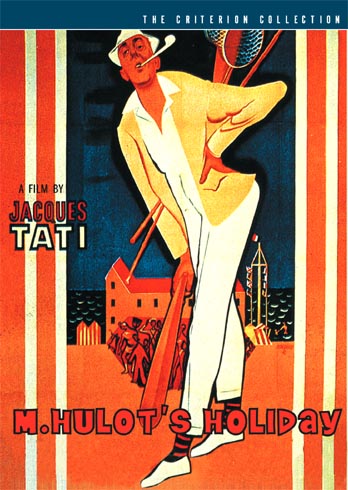
M. HULOT'S HOLIDAY (110)


The Film: M. Hulot's Holiday (110)
The Director: Jacque's Tati (Mon Oncle (111), Playtime (112))

What Is It: The first of three Jacque Tati, semi-surreal, almost-entirely-silent films starring Tati's character M. Hulot.  Bumbling, and surprisingly charming, M. Hulot journeys to a seaside vacation town and, well, generally causes trouble.

A Lil' Bit of History:  M. Hulot's Holiday (110) was Jacque Tati's first dance with this renowned bumbler.  Tati played the character in the four films he made over the course of his career, each one a monstrous hit.  As Roger Ebert writes, "There was a time when any art theater could do a week's good business just by booking Hulot.''

The Expectation: I was on a high coming out of my surprising enjoyment of The Scarlet Empress (109) and as a burgeoning film snob I'm required to be excited about any French film from 1980 or before.  Thus, I was keener than keen.

The Experience:  Life really took a front seat for a while here at the old Criterion Quest.  Hulot and his wonderful holida were always present, always lingering in the back of mind, but it took weeks and weeks of self-motivation to finally sit down and swirl my toes in this beach-side comedy.


Strangely enough, whilst watching M. Hulot's Holiday (110) I found myself thinking about The Marx Brother's famous Duck Soup and the differences between the films and how they seem to unintentionally observe the very opposing traits of the two origin countries.  Duck Soup is an assault on the senses, a machine-gun rattle of jokes, insults and near-psychotic bouts of hilarious violence that leave you dry-mouthed and confused.  M. Hulot's Holiday (110) is, quite literally, a trip to the beach, a slowly-paced, saunter through a stylish world of France's bourgeoisie, interjected with dalliances of surreal humor that are appreciated but not necessarily gut-laughs.  Where Grouch and company are borderline obnoxious (in the most gratifying of ways), M. Hulot is a lovable dope, a silently spinning vortex of distraction that unknowing pulls all within striking distance in.

Both films play with the notion of the ruling class, the government, the need for change.  Duck Soup puts us at the forefront of the action.  Rufus T. Firefly is, quite quickly, the ruler of a country, and all of his actions are direct satires of the fumbling American government.  In M. Hulot's Holiday (110) we're given a look at the upper classes strict routines - the dinner bell, the beachside walks, the tightly-assed annoyance of those disturbed - and M. Hulot is a quiet bull in the China shop.  He's not trying to break anything, but his mere presence is enough to, quietly, turn these routines on their head.  He's a distraction - in tennis, in the dining hall, on the beach - that forces bridge-playing upper class to stop what they're doing and turn around.   In the final moments of the film as M. Hulot and Martine (Nathalie Pascaud) dance, alone in the dining room, every one is watching.  Jealous?  Maybe, but certainly aware that something else exists outside of their small little bubbles.

And here's where the difference between America and France sticks out the most.  The big, bold presence of the Marx's brother was how America wanted to be seen.  A sizable presence that "walked tall and carried a big stick."  And sure, Duck Soup pokes fun at the idea, but at the same time it embodies the in-your-face stylings of American comedy.  It's gaudy and broad and absolutely hilarious.  In comparison, in general, M. Hulot's Holiday (110) is stylized and sweet, a warm breeze off the ocean, that you smile at each and every time it rustles your hair.  I know little about France, but from stereotypes alone, I imagine that this sort of quiet humor embodies much of the Frenchie's way of thought.  Poke fun, but do so politely.

---

Criterion Counsel: Mon Oncle (111) is Tati's second attempt (in color) and it features a Jetson's like house of the future.  Hulot and hilarious modernity?  I'm in.