Showing posts with label m. hulot. Show all posts
Showing posts with label m. hulot. Show all posts
Friday, April 30, 2010
sylvain chomet's upcoming tribute to jacques tati
I know, my obsession with Tati has no end, but when you hear that the director of the amazing Triplets of Belleville has recently completed a film, entitled The Illusionist, based on an unfinished screenplay by the French comic master my mouth gets a little wet around the edges.
Though I can't believe that Hulot will actually appear in the film, the main character, an aging magician fumbling his way through the changes in modern France, is based on the bumbling everyman. Look at that stance, the way he spins a cane! Hulot, he lives again.
Color me excited.
---
criterion counsel: i have fallen asleep the last three nights and the dvd has spun it's way to a similarly blaring big band dance scene each night. last night i got a little further in the film though and couldn't be more excited. it has that feel of a great caper flick - the team, the plan, the heist - but all turned on its merry head.

Tuesday, April 13, 2010
monsieur hulot you will not smoke
Not exactly current news, but the French, stringent observers of taste and culture that they are put the kibosh on the iconic pipe of one M. Hulot last year, decorating posters of the befuddled comedian with yellow sparks over his signature smoking vessel.
Aghast you disrespecting Frenchies you.
The crime (quite punishable if you ask me) in question:
 An explanation:

---
Criterion Counsel: Soon my friends, soon.
Aghast you disrespecting Frenchies you.
The crime (quite punishable if you ask me) in question:

---
Criterion Counsel: Soon my friends, soon.
Monday, April 12, 2010
MON ONCLE (111)

The Film: Mon Oncle (111)
The Director: Jacques Tati (M. Hulot's Holiday (110), Playtime (112))
What Is It: The second in Criterion's three-disc set of all things Jacques Tati. Tati was, and continues to be posthumously, a renowned comedic director and actor. The moustached director used his character M. Hulot (a sort of bumbling everyman) to poke and prod at the machinations of the post-war French government. In Mon Oncle (111) we find M. Hulot breaking and bumbling his way through the post-war consumerism that, ahem, consumed France in the wake of World War II. There's post-modern houses, oil spewing fish statues, and a slew of oddly dressed socialites.
A Lil' Bit of History: On its release, Mon Oncle (111) was, to a degree, critically reviled as many of the to-do critics at the time saw is un-patriotic in its depiction of a France awash with needless spending and industry. This lasted only as long as the film wallowed in the shadows, barely weeks before the international press rejoiced, awarding it the Oscar for Best Foreign Film, amongst others.
The Expectation: Another spot-on, darling romp from a master of French cinema I'd previously been un-hip to.
The Experience: I started a business with the Criterion Conquistador and our good friend Dartanyan, thus this film was lost in the cracks for a long while. It may have been almost a month, or longer since I started the film, but in the wee hours of the morning today I crossed the Mon Oncle (111) finish line.

M. Hulot is as subversive as a pipe bomb thrown through a storefront. Yes, the nattily dressed everyman, seems only to fumble his way through each and every set piece, in his gentle manner he's flipping an enormous bird to all the rumbling mechanics of the French government. The scene: a provincial town in France slowly being consumed by the shining metal of the post-modern consumerism. M. Hulot stays at his brother-in-law's Jetson like house, rife with automated switches and stark interiors. Over the course of the film, Hulot interacts with the beacons of the upper-crust, a series of stuffed-shirt CEOs and other fans of the rampant consumerism. Never does Hulot aggressively poke fun, he just lives his life, a simple polite existence, and everything else just looks absurd in comparison. Throw in a town full of the sort of smiley drunks and working class individuals Tati populates all his films with and this is muted attack on French aristocracy.
2. Monsieur Arpel
No one speaks a great deal in the films of Jacque Tati. He's a master of painting a scene and allowing the physical aspects of comedy run amok. But Monsieur Arpel (Jean-Pierre Zola) is even less need of words. He is a sausage of a man, squeezed in to expensive suits, an almost physical representation of all things wealthy. He forces himself in to boat-like cars, his sheer bulk echoing the needless spending he's obviously a perpetrator of. As I watched the film this morning I couldn't take my eyes off of him.
3. So simple and quiet.
I can't imagine an American film in the 1950s that could exist without the influx of constant chatter. Yes, some of the Westerns at the time dilly-dallied with silence equaling strength, but Tati creates a world where conversation is background noise, an ambient addition that helps highlight the proceedings at hand (most likely M. Hulot absent-mindedly breaking something). Characters speak (more so in Mon Oncle (111) than M. Hulot's Holiday (110)) but what they say means nothing, instead we as an audience are lost in the simple sound effects, the scene composition, the spewing blue liquid of a broken fish. I found myself bored at first when watching these films, and I imagine anyone beaten down with the sort of slam-bam filmmaking of the US of A would be, but allow yourself to slide in to the world Tati creates. It's not big and bold but nonetheless all-inclusive. A slighty, silly bit of existence that might not make you laugh out loud, but will linger in your mind on the bus, on a walk, on the vertiginous edge of sleep.
---
Criterion Counsel: Riding high after completing a film. Trying to finish off Playtime (112) the third and last Tati film in the days to come. Wish me luck ardent readers, I've needed it lately.
Thursday, April 8, 2010
a forgotten behemoth
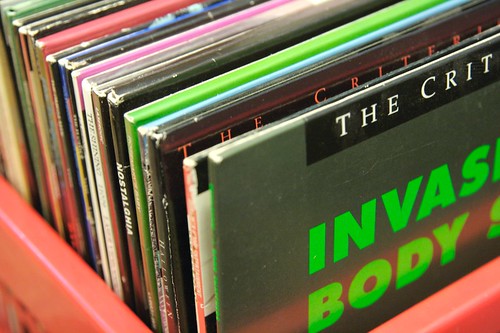
I stumbled upon a stack of somewhere between 80 and 100 laserdiscs yesterday. Films that ranged from the seminal transfer of Snow White to the Brian DePalma's Nic Cage eye-roller Snake Eyes. Quite honestly, I've barely searched through this pile of digital frisbees as the concept of laser discs was a brief flash in my eye somewhere around my freshmen year in high school.
But it makes me wonder? Is there still a small handful of laserdisc enthusiasts out there drooling over a clean copy of Lost Boys? Is this three hundred pound pile of oversized CD worth something to someone out there?
Or maybe this distaste of laserdiscs is just another slew of misguided ageism. Perhaps these hulking behemoths are truly the greatest, the sharpest, the best sound versions of these films, and I, already well on my way in to the wilds of DVD-dom by the time I even had the financial means to purchase a laserdisc, have unjustly dismissed them. Perhaps I should be in the market for a device that will allow me to peruse these monstrous bits of filmic vinyl.
Or perhaps I should throw a 1 dollar price tag on each and every one of them, stuff them in to a dirty cardboard box, and let someone who cares a little bit more indulge to their hearts content.
Thoughts film enthusiasts on laserdiscs and their ill-fated careers?
---
Criterion Counsel: The goings are rough. Criterion Conquistador and I are planning to power through the remaining M. Hulot pictures this weekend. But after a slew of evenings where I've nearly passed out standing, this is a bold claim.
Subscribe to:
Posts (Atom)