Monday, March 8, 2010
A few thoughts on The Oscars
Had a lot of Oscar-related thoughts kicking around the dusty attic twixt my ears and I thought, in smaller perhaps more digestible screes, I'd air 'em out.
Little gold man, I present you with vitriol.
They've always been a bit of a big deal in the Sanders family. I credit an enormous amount of my adoration of cinema to my mother's twitchy-eyed obsession with the glitz and glamour of the yearly Hollywood telecast. As I've grown older, and more keen on the corporate pie-fingering so troubling in Tinseltown, I've lost some interest in the big show.
This years show? Unsurprisingly ho hum. The producers continue to marginalize the host's ability to smart-aleck the audience. The speeches, oh the speeches, continue to be laundry lists of veritable unknowns, and I'm always baffled at why folks thank The Academy. My most egregious complaint? They chose to include 10 pictures for the coveted Best Picture category and do they reach out across the land to stock the larders with interesting and unique films to balance out the steaming piles already guaranteed spots? Not a chance. Instead they backslide, awarding a handful of truly awful films chances to take home Oscar gold.
Now I haven't seen it, but The Blind Side? My initial viewing of the trailer had me wondering who'd snuck the Lifetime Channel on to my computer. Is this the direction the Oscars are veering towards cramming absolute sentimental pap around true winners like The Hurt Locker and to some degree, Avatar? In lieu of Sandra Bullock vehicles, why not plug the newly minted Best Picture holes with deserving independent films or foreign pictures or a healthier dose of genre pictures? Because these smaller pictures aren't going to bring in the piles of money the suit-and-tie, sun-tanned execs running the movies need to sleep on at night.
I think what bothers me the most about the blockbuster-clogged Best Picture category is the possibility that could exist. Regardless of your feelings about the Oscars, the broadcast is watched by an enormous selection of people. The films that are nominated are going to get a boost regardless of what they are, as just the nomination creates interest. Thus, why not let smaller, more intelligent films gain some of the kudos, financial and critical, the Best Picture noms are lauded with?
Why not create a film culture based around quality and not financial success?
I'd love to know.
----
Criterion Counsel: Making headway.
Labels:
AVATAR,
hurt locker,
oscars,
the blind side
Friday, March 5, 2010
The Screener, pt. 1.
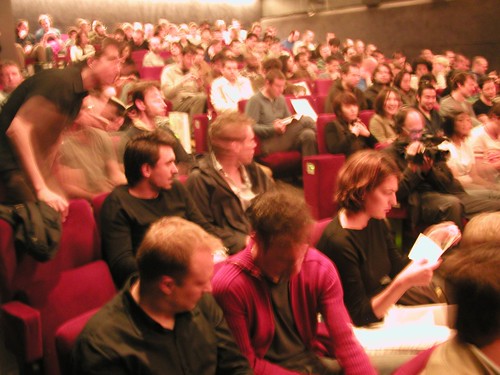
Public screenings are funny things. I imagined, when I first started doing this pseudo film-reviewing gig screeners would be private affairs filled with hirsute intellectuals debating the pros and cons of late Kurosawa and the like. I imagined angered stares when cell-phones rang, the gentle sound of pen scratching note-paper, and the scent of pensive viewing permeating the air.
I was exceptionally wrong. Public screenings are chaotic in nature. Various outlets (radio stations, blogs, production companies, etc.) advertise for screeners of their films in a variety of ways: ticket giveaways, flyering, free passes to the public, etc. There's never a mention in any of these advertising forms of the fact that theaters have limited seats and in terms of early screenings, nearly half of those limited seats are reserved for press. Thus the mob that arrives hungry for free cinema, is always, much to their surprise only partially allowed in. Even those "lucky" film-goers released in to the cinema, are then faced with a selection of seats abysmal to say the least. The press section of a public screener is almost the entire middle of the theater. A hefty chunk of the center section is plastered with obnoxious red "Reserved Section" signs, forcing the lovers of free film in to tight sections close to the screen or in the far back of the cinema.
Almost always, every single time, there's anger about the press section. Loaded down with popcorn and candy, the public always attempts to just circumvent the various Promotions people and plop themselves down in the prime seats ten rows back, center. And almost always, said Promotions people appear out of nowhere to redirect them to some tiny nook. The early moments before any of these screenings always seem anxiety-charged, with people looming on the edges waiting for the chance to drop themselves in to a seat once reserved for press, or angrily espousing their hatred of the privilege inherent in the reserved seating. I find myself half-amused by the proceedings, hunkered down in my gated community, waiting to watch the newest blockbuster early. At times though I'm worried, "Are these free-cinema loving fans going to take out their misguided anger on we who've been giving the opportunity to enjoy the center seats?" All of sudden I feel upper class, I feel as if I've got something someone else isn't allowed, and quite honestly, it makes me feel a little jumpy.
My worry, in the moments before the film starts, is that the always raucous screener crowd will be unable to contain their excitement during the film and I'll have to silently curse the public throughout, distracting me from my precious movie, and there by running my experience. Up to now (and Alex claims that this is always true) the screeners have been perfect in their audience participation. Cellphones have been kept to a minimum, talking has been almost non-existent, and the audience has clearly enjoyed the films whooping and hollering when necessary, gasping when scared. These screener audiences have been some of the best I've encountered.
I've got a lot to say on this newly experienced screener. Next time I'll be talking about what I like to call "screener profiling" a curious side-topic to the screener that I find fascinating.
---
Criterion Counsel: Today my friends, today I finish M. Hulot's Holiday (109).
I was exceptionally wrong. Public screenings are chaotic in nature. Various outlets (radio stations, blogs, production companies, etc.) advertise for screeners of their films in a variety of ways: ticket giveaways, flyering, free passes to the public, etc. There's never a mention in any of these advertising forms of the fact that theaters have limited seats and in terms of early screenings, nearly half of those limited seats are reserved for press. Thus the mob that arrives hungry for free cinema, is always, much to their surprise only partially allowed in. Even those "lucky" film-goers released in to the cinema, are then faced with a selection of seats abysmal to say the least. The press section of a public screener is almost the entire middle of the theater. A hefty chunk of the center section is plastered with obnoxious red "Reserved Section" signs, forcing the lovers of free film in to tight sections close to the screen or in the far back of the cinema.
Almost always, every single time, there's anger about the press section. Loaded down with popcorn and candy, the public always attempts to just circumvent the various Promotions people and plop themselves down in the prime seats ten rows back, center. And almost always, said Promotions people appear out of nowhere to redirect them to some tiny nook. The early moments before any of these screenings always seem anxiety-charged, with people looming on the edges waiting for the chance to drop themselves in to a seat once reserved for press, or angrily espousing their hatred of the privilege inherent in the reserved seating. I find myself half-amused by the proceedings, hunkered down in my gated community, waiting to watch the newest blockbuster early. At times though I'm worried, "Are these free-cinema loving fans going to take out their misguided anger on we who've been giving the opportunity to enjoy the center seats?" All of sudden I feel upper class, I feel as if I've got something someone else isn't allowed, and quite honestly, it makes me feel a little jumpy.
My worry, in the moments before the film starts, is that the always raucous screener crowd will be unable to contain their excitement during the film and I'll have to silently curse the public throughout, distracting me from my precious movie, and there by running my experience. Up to now (and Alex claims that this is always true) the screeners have been perfect in their audience participation. Cellphones have been kept to a minimum, talking has been almost non-existent, and the audience has clearly enjoyed the films whooping and hollering when necessary, gasping when scared. These screener audiences have been some of the best I've encountered.
I've got a lot to say on this newly experienced screener. Next time I'll be talking about what I like to call "screener profiling" a curious side-topic to the screener that I find fascinating.
---
Criterion Counsel: Today my friends, today I finish M. Hulot's Holiday (109).
The Work of Al Jarnow
Al Jarnow was a big name in animation for a long time. Cut his teeth working on such animation hotbeds as the old school Sesame Street shows. I was never a Sesame Street kid myself, I preferred the kicks and punches and costumes of Batman and the Power Rangers, but now, as a pseudo-adult, Jarnow's work just speaks to me.
Lucky for us, for you and me, Jarnow's collected works (40 shorts and an Al Jarnow-centric documentary) are being put out by the bastions of all things amazing, The Numero Group. The collection is entitled Celestial Navigations and I can only wish it was my birthday so I could harangue some friend or another in to gifting it to me.
Wednesday, March 3, 2010
QUICK NOTES: Ballast, d. Lance Hammer
In my gentle opinion, every film I watch merits a write-up. Perhaps it isn't the academic dissection of a great film, or the study of a film in its chronological context, but still, I believe, and please disagree with me (everyone else seems to), that ever film warrants discussion. Yes, this discussion may just for me to better place the film within the vast filmic storage unit that is my brain, but perhaps a brief write-up will get you excited, stray your opinion, turn you on to a burst of cinema you'd have blindly passed in the street.
Or maybe it's just because I love to write about film.
---
The Film: Ballast
The Director: Lance Hammer
The Hype: Quite honestly, I can't recall as to where or when or why I've heard about this film. A roommate (two roommates actually) had mentioned it in passing, but somewhere amongst the stunning disorganization of my life, it must've slipped my mind. That said, Ballast swept and mopped the award shows in 2008, and when it serendipitously fell in my possession I dove right in.
The Truth: Filmed in beautiful desolation of the Mississippi Delta, Ballast focuses on the relationship between a depressed twin (Michael J. Smith Jr.), his nephew (JimMyron Ross) and sister-in-law (Marlee) in the wake of his brother's suicide. The Mississippi Delta is a stark and dangerous seeming place for a bored teenager to be running amok, and with the help of a group of non-actors, director Lance Hammer brings this harsh reality to life in a poetic, yet stunningly realistic manner.
I was most impressed with Michael J. Smith Jr.'s portrayal of the obviously intelligent yet numbingly depressed twin Lawrence. There's a deep set softness in the character, a sort bumbling naivete, hardened by a sharp edge of lonely anger against the world. The film follows Lawrence as he's forced, at gunpoint even, to re-enter the life of a woman, and her child, who hate him, and Hammer show's us the world with out reserving any judgment. These characters are immensely broken and attempting to survive in a world that continues to pile on the misery, and this film isn't about their redemption or their success, it's just about them, and the small period of life in which we get to view them.
Final Thoughts: As I get older and view more films, I find more and more enjoyment in these weighty character studies. I've grown bored with big budget (as any aging film fan should) and this sort of quiet, tense look in to a whole different way of living was both gorgeous and fascinating.
Or maybe it's just because I love to write about film.
---
The Film: Ballast
The Director: Lance Hammer
The Hype: Quite honestly, I can't recall as to where or when or why I've heard about this film. A roommate (two roommates actually) had mentioned it in passing, but somewhere amongst the stunning disorganization of my life, it must've slipped my mind. That said, Ballast swept and mopped the award shows in 2008, and when it serendipitously fell in my possession I dove right in.
The Truth: Filmed in beautiful desolation of the Mississippi Delta, Ballast focuses on the relationship between a depressed twin (Michael J. Smith Jr.), his nephew (JimMyron Ross) and sister-in-law (Marlee) in the wake of his brother's suicide. The Mississippi Delta is a stark and dangerous seeming place for a bored teenager to be running amok, and with the help of a group of non-actors, director Lance Hammer brings this harsh reality to life in a poetic, yet stunningly realistic manner.
I was most impressed with Michael J. Smith Jr.'s portrayal of the obviously intelligent yet numbingly depressed twin Lawrence. There's a deep set softness in the character, a sort bumbling naivete, hardened by a sharp edge of lonely anger against the world. The film follows Lawrence as he's forced, at gunpoint even, to re-enter the life of a woman, and her child, who hate him, and Hammer show's us the world with out reserving any judgment. These characters are immensely broken and attempting to survive in a world that continues to pile on the misery, and this film isn't about their redemption or their success, it's just about them, and the small period of life in which we get to view them.
Final Thoughts: As I get older and view more films, I find more and more enjoyment in these weighty character studies. I've grown bored with big budget (as any aging film fan should) and this sort of quiet, tense look in to a whole different way of living was both gorgeous and fascinating.
Labels:
ballast,
lance hammer,
michael j smith jr,
QUICK NOTES
Tuesday, March 2, 2010
THE BASICS: Manhattan
What is The Basics? In brief:
Drew McWeeny (of Ain't It Cool fame, now prolifically covering film over at Hitfix) will throw out a film that he considers a must see for any film fan, a film that William Goss (a film lover in my own vein, versed but not encyclopedic, chugging away over at Cinematical, surely as we speak) will watch and respond to. What McWeeny hopes is that in discussing these classic films he'll not only give readers an assortment of films to peruse in their own time, but also start a conversation about these important pieces of culture.
I love film. You might call me a film "geek". I might secretly feel sort of sad when I wake up to a sunny day, knowing that I'll spend it outside away from my precious films. Truthfully though, the gaps in my film knowledge could fit whole theaters in them. I haven't seen all the great works by all the great directors (let alone the American masters) or dug in deep to the exploitation genre. I can't name off every film starring Steve McQueen or tell you what film won Best Picture in 1965. But I want to. Thus, with McWeeny throwing down the gauntlet, I've decided to follow along.
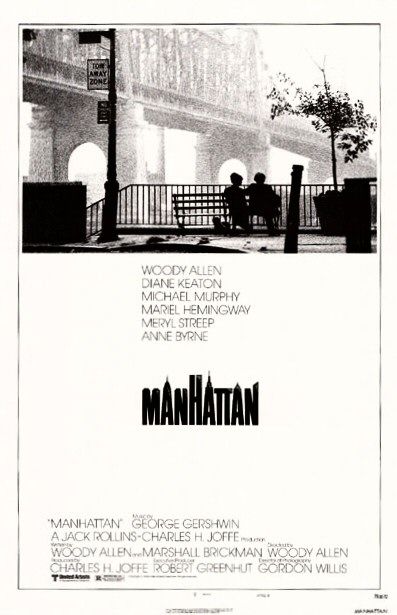
His second choice is Woody Allen's Manhattan. Now I've seen a lot of Woody Allen, but somehow, someway, I've completely and totally missed out on this, his oft times claimed masterwork.
Check out McWeeny's post HERE, and then William Goss's response HERE.
---
I'm conflicted when it comes to Woody Allen. As much as I love his classics (the one's I've seen) - Annie Hall, Hannah and Her Sisters, Sweet & Lowdown (minor classic) - I think at times the characters he writes for himself (or whatever high-profile performer he's shuffling in to the role of nebbish worry-wart) border on caricature. I was shocked at times during my watching of Manhattan how much Woody Allen, both in delivery and appearance, reminded me of Groucho Marx. The eyebrows, the softly spoken follow ups to his gags, the thick glasses and machine gun comedy - Woody Allen and Groucho Marx are like distant cousins. But where Marx and company seemed blissfully happy to leap in to insanity, I alway expect a great sense of subtlety from Woody Allen, a restraint that reflects the intellectuals he always plays.
In Manhattan though, sweet, amazing Manhattan, Woody Allen sheds the cigar-chompin' caricature of Sleepers and Bananas and creates a film that shows not only the humor in the lost love and remorse of a broken relationships, but the deep pain and sadness it creates.
Woody Allen plays Isaac, a burgeoning writer dating a seventeen year-old. His good friend Yale (Michael Murphy), is married and having an affair with Mary (Diane Keaton). When Yale introduces Isaac to Mary, Isaac begins to question his relationship with Tracy (the seventeen year old played with amazingly sincere innocence by Mariel Hemingway). It's simple and direct, and allows Woody Allen to add a layer of emotion to the character he'd been building in films like Annie Hall.
Manhattan is still a film about Woody Allen and the character he's defined and redefined over and over again throughout his career. Insecure and anxious, quick with a razor-sharp bit of observation, Isaac is the nebbish ladies man Woody Allen always seems to write (and I consider a mark of his talent that he can always make me believe that 5'3" Jewish writer from New York could bag both Mariel Hemingway and Meryl Streep). What's different in Manhattan is that this nebbish character doesn't just steamroll over the women in his life, instead Isaac makes errors, mistakes, and he feels pain because of it. There's a scene near the end of the film when Isaac admits to Yale's ex-wife (Anne Byrne Hoffman) that he's made an error in letting go of Tracy, and instead of it being a joke or a gag, it's a truly personal monologue. Isaac knows he's made an error, knows that he's lost the woman that truly inspires him, that he might actually love. And as Isaac confesses to the camera you can see it in his eyes, his slumped shoulders, the slow-ish rhythm of his voice. He's done something wrong, and in Manhattan those mistakes have true emotional resonance.
You might say that Manhattan is the logical progression of Woody Allen's stock cast of characters. Diane Keaton's Mary isn't the bubbly goofball of Annie Hall, she's a hard-nosed writer, rife with nervousness and fears, Ms. Hall ten years in the future, her heart and persona battered around a bit by a rough series of break-ups. And that's what draws me to Manhattan in a way so many of Allen's newer films (hell, early films) fail to do - the sense of consequence to the actions of these characters. It gives a depth to Allen's humor, a sense of pathos to his witty repartee that just gets me right under the rib cage.
---
Criterion Counsel: I don't even want to talk about it.
Drew McWeeny (of Ain't It Cool fame, now prolifically covering film over at Hitfix) will throw out a film that he considers a must see for any film fan, a film that William Goss (a film lover in my own vein, versed but not encyclopedic, chugging away over at Cinematical, surely as we speak) will watch and respond to. What McWeeny hopes is that in discussing these classic films he'll not only give readers an assortment of films to peruse in their own time, but also start a conversation about these important pieces of culture.
I love film. You might call me a film "geek". I might secretly feel sort of sad when I wake up to a sunny day, knowing that I'll spend it outside away from my precious films. Truthfully though, the gaps in my film knowledge could fit whole theaters in them. I haven't seen all the great works by all the great directors (let alone the American masters) or dug in deep to the exploitation genre. I can't name off every film starring Steve McQueen or tell you what film won Best Picture in 1965. But I want to. Thus, with McWeeny throwing down the gauntlet, I've decided to follow along.
His second choice is Woody Allen's Manhattan. Now I've seen a lot of Woody Allen, but somehow, someway, I've completely and totally missed out on this, his oft times claimed masterwork.
Check out McWeeny's post HERE, and then William Goss's response HERE.
---
I'm conflicted when it comes to Woody Allen. As much as I love his classics (the one's I've seen) - Annie Hall, Hannah and Her Sisters, Sweet & Lowdown (minor classic) - I think at times the characters he writes for himself (or whatever high-profile performer he's shuffling in to the role of nebbish worry-wart) border on caricature. I was shocked at times during my watching of Manhattan how much Woody Allen, both in delivery and appearance, reminded me of Groucho Marx. The eyebrows, the softly spoken follow ups to his gags, the thick glasses and machine gun comedy - Woody Allen and Groucho Marx are like distant cousins. But where Marx and company seemed blissfully happy to leap in to insanity, I alway expect a great sense of subtlety from Woody Allen, a restraint that reflects the intellectuals he always plays.
In Manhattan though, sweet, amazing Manhattan, Woody Allen sheds the cigar-chompin' caricature of Sleepers and Bananas and creates a film that shows not only the humor in the lost love and remorse of a broken relationships, but the deep pain and sadness it creates.
Woody Allen plays Isaac, a burgeoning writer dating a seventeen year-old. His good friend Yale (Michael Murphy), is married and having an affair with Mary (Diane Keaton). When Yale introduces Isaac to Mary, Isaac begins to question his relationship with Tracy (the seventeen year old played with amazingly sincere innocence by Mariel Hemingway). It's simple and direct, and allows Woody Allen to add a layer of emotion to the character he'd been building in films like Annie Hall.
Manhattan is still a film about Woody Allen and the character he's defined and redefined over and over again throughout his career. Insecure and anxious, quick with a razor-sharp bit of observation, Isaac is the nebbish ladies man Woody Allen always seems to write (and I consider a mark of his talent that he can always make me believe that 5'3" Jewish writer from New York could bag both Mariel Hemingway and Meryl Streep). What's different in Manhattan is that this nebbish character doesn't just steamroll over the women in his life, instead Isaac makes errors, mistakes, and he feels pain because of it. There's a scene near the end of the film when Isaac admits to Yale's ex-wife (Anne Byrne Hoffman) that he's made an error in letting go of Tracy, and instead of it being a joke or a gag, it's a truly personal monologue. Isaac knows he's made an error, knows that he's lost the woman that truly inspires him, that he might actually love. And as Isaac confesses to the camera you can see it in his eyes, his slumped shoulders, the slow-ish rhythm of his voice. He's done something wrong, and in Manhattan those mistakes have true emotional resonance.
You might say that Manhattan is the logical progression of Woody Allen's stock cast of characters. Diane Keaton's Mary isn't the bubbly goofball of Annie Hall, she's a hard-nosed writer, rife with nervousness and fears, Ms. Hall ten years in the future, her heart and persona battered around a bit by a rough series of break-ups. And that's what draws me to Manhattan in a way so many of Allen's newer films (hell, early films) fail to do - the sense of consequence to the actions of these characters. It gives a depth to Allen's humor, a sense of pathos to his witty repartee that just gets me right under the rib cage.
---
Criterion Counsel: I don't even want to talk about it.
Labels:
annie hall,
diane keaton,
Manhattan,
sweet and lowdown,
THE BASICS,
woody allen
Monday, March 1, 2010
Ben Stiller's aging face.
I have issues with aging. The slow degradation of items, objects, landscapes, and most scarily, we as human beings. At times I find it difficult to purchase new things because I know that even if they look amazing, spotless, untouched within the hard plastic shells of their packaging, as soon as I remove them from their consumer armor, they'll be dinged, dirty, already on the long (or short) road to decomposition.
I saw the new film by Noah Baumbach, Greenberg, last week and, regardless of my glowing anxious love for the film, was shocked by Ben Stiller's appearance. It isn't that he looks different, or deformed, rather, he looks more like Ben Stiller. There's the famous Michelangelo saying about he wasn't trying to carve anything out of rock, but rather trying to remove the bits and pieces of that were surrounding what was already there. That's what Stiller's face in Greenberg reminded me of, as if the years of life he's lived have slowly peeled away the parts that weren't him, revealing this perfect representation of Ben Stiller.
Of course this could be a trick of the camera, an intentional move by Baumbach and company. Stiller's character in the film is an anxious mess, the sort of outwardly-blaming headcase that life drags at. He writes letters to big corporations, lashes out at those who thinks who are wrong - he's pretty much that kind of asshole. Thus, the newly taut lines of Stiller's face might have been played up to point out that life has hardened this man.
But I think not. I think Stiller, as he gets older, is becoming all angles, the softness of his face peeling away to the point of caricature. He's condensing, the pressure of age, contracting his features in to a compounded version of the Stiller we know and love. I wonder how, with Stiller still blindly attaching himself to ridiculous concept-comedies, his now-more angular face, rife with pained anxiety, will play. Is he going to be forced in to an era of seriousness due to his ever-sharpening visage?
If his performance in Greenberg has anything to say of it, I certainly hope so.
The story up to now ...
In the last two months, these things have happened:
1. I quit my long-time job at Light In The Attic Records in the hopes that I could focus on my own projects. This created the near perfect situation where I work for barely three days a week, still managed to live in a fantastic part of the city, and had four days to focus on my true loves: films, films, and films.
2. Literally a week after deciding that LITA was no longer the home I wanted to have, I received an email from another blog I write for informing me that with the lightest flick of the wrist I would now be on a screener list for the greater San Francisco area. This would mean that nearly any and all films that opened on the big screen in my area, the Yay Area, I would be invited to, sans payment, to reflect upon and then review. Life long goal accomplished. Pop the bubbles, turn on the hottub, cook up a steak.
3. For the last three, maybe four weeks, I've literally been immersed in film. I worried at first that because of Side One: Track One's smallish readership that perhaps I would only be invited to the films that every outlet was allowed. Or even worse I be shuffled in to side theaters to see made-for-television melodramas and focus group discussions. As I often do when presented with anxiety, I started knockin' on doors to make sure that all was right and the floodgates were open for Hurricane Noah to slide through. I've been sending emails, by the bucket full, to those in charge of screeners to make sure that the films that are being released each and every week are being viewed ... by me. My first week I saw three films, then two, films and now steadily, for the last two I've seen four films a week, sometimes two a day. A literal engorgement of cinema. I'm bloated, but Jesus, if this isn't the life for me.
You can follow my reviews, for the moment at Side One: Track One, and I'll surely be linking to each and every film as I review them.
4. On top of that, my beautiful Criterion Conquistador has started a new business involving the excavation and sale of dead people's effects. The talented lady, and her equally talented business partner are in all engines go mode and as a diligent supporter (and infatuated follower) I've been assisting as much as possible. Eleven hours spent amidst Jesus paraphernalia and rat shit, as you might imagine, can be a bit exhausting.
5. Thus my Quest, my sweet sweet Quest, has fallen behind a bit. I've been festooned amongst Jacque Tati's near-silent masterworks for weeks now, and with four films bubbling up on the horizon and a trip to San Luis Obispo and, and, and ... well, lets just say it might be a while. But in the meantime, as I've said recently and frequently, this blog will continue, and for god's sake it will be more about film and my increasing love for it, than ever before.
Stay with me people. Stay with me.
---
Criterion Counsel: Have spent the last three days watching Manhattan. The French must be put on hold when Manhattan comes a-callin'.
Subscribe to:
Posts (Atom)